
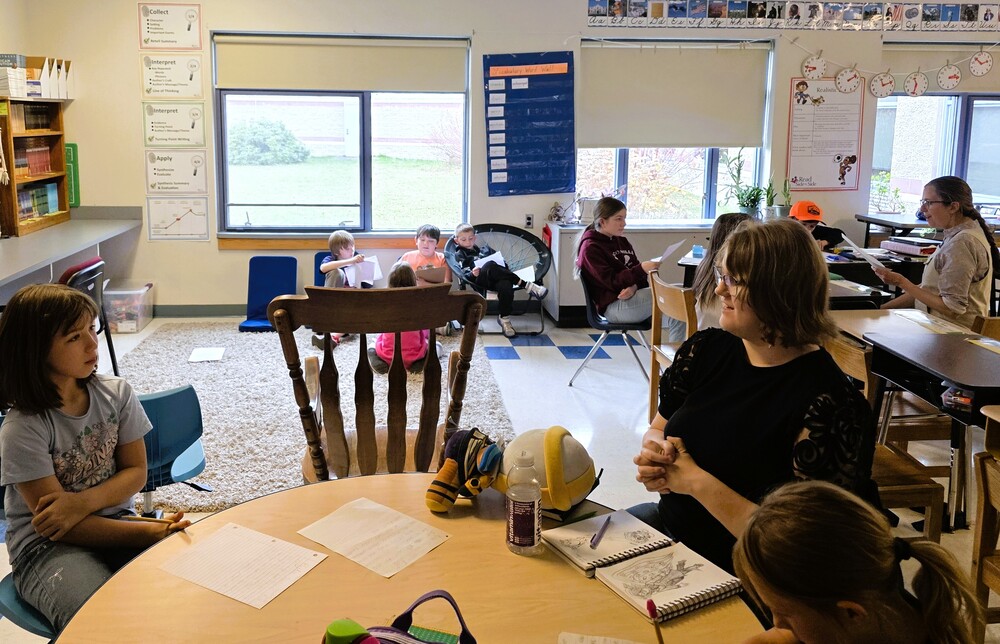
Walk into any classroom at St. Regis Falls Central School, and you will see literacy in action. Teachers, staff, and educational leaders are working together to elevate reading and writing skills.
Literacy is an important part of the district’s efforts to strengthen instruction and support student success. It’s one of the focus areas of the newly established District Improvement Group (DIG). The group reviews student data, identifies needs, and explores strategies that align with the district’s School Comprehensive Education Plan (SCEP).
To incorporate this work into daily practice, St. Regis Falls has expanded its instructional support team. Through the Coaching for Excellence program, a state-funded initiative, the district has welcomed Instructional Coach Sheryl Carter to work alongside teachers.
“What has encouraged me most is our teachers’ openness and enthusiasm for learning together. They bring valuable experience, thoughtful ideas, and a strong commitment to their students,” said Carter. “I am excited to be part of this team as we work together to strengthen literacy across grade levels and subject areas and help every student grow as a reader, writer, and thinker.”
The district also welcomed Lisa Dupree, a retired elementary principal and BOCES curriculum support specialist, who visits two days each week to identify learning gaps and support instruction.
“So far this year, I have conducted classroom learning walks with Lisa and met with teachers to discuss their needs and goals,” added Carter. “I have also designed weekly collaborative planning sessions where teachers work in small groups to plan together, analyze student data, and explore literacy strategies.”
Classroom Implementation and Collaboration
Teachers are finding ways to challenge students to do more than memorize—they are building reasoning, sense-making, and problem-solving skills across all subjects. Examples of this work can be found throughout the building, with student collaboration often acting as a central thread aligning daily practice with district goals.
Elementary Special Education teacher Nicole Wagner is using peer collaboration to deepen reading comprehension and student engagement in English Language Arts.
"When I have my students do a summary after reading quadrants of our novel, my students are given the choice to collaborate with their peers by choosing a partner to work with and completing their work together to achieve the same grade," shared Wagner. "They get a choice board to choose from and they work together on the project. My students love it and it gives them a chance to give me a glimpse of their creative side."
Literacy and collaborative learning skills extend into specialized subject areas as well. In the art room, teacher Madison Mundy is using group projects to build visual literacy, critical thinking, and vocabulary skills.
"I had fourth grade working on identifying landscape foreground, middle ground, and background. They drew their individual parts on whiteboards, but had to work together to make sure they would line up,” explained Mundy. “When students get to collaborate, they get their minds exploring, but it also helps them remember the activity and the lesson more!"
Cross-grade partnerships are also building skills throughout the school. Marianne Augenstein's fourth through sixth grade Enrichment class recently partnered with Peter Crowley's Senior Creative Writing class for a joint poetry workshop.
"Each student chose a different season, and then wrote a section of a group poem. They brainstormed, did peer editing, and practiced reading their poems with expression and confidence,” shared Augenstein. "I am really enjoying working with this group, and I feel like we've made some wonderful progress on their writing skills.”
Supporting Literacy Beyond the Classroom
Critical thinking and literacy skills developed in school are most effective when reinforced at home. Families can support the district's literacy goals by encouraging students to explain the reasoning behind their answers on homework, discussing reading assignments together, and modeling active reading habits daily.